


AI Expertise / Oracle Modernization
Modernize Oracle Forms with AI-Assisted APEX Conversion
Turn legacy Oracle Forms into modern APEX applications with F2A, OneGlobe's AI-assisted modernization solution.
Reduce manual redevelopment with automated APEX generation and AI-assisted PL/SQL conversion. Understand application complexity, carry business logic into the new application, and review validated output with your team.
Forms XML Inventory
Pick Forms XML modules and shared libraries (.pll). Selected forms stay queued until you stage them for conversion.
0 staged forms
Read, Map & Build in APEX
Analyze staged Forms XML, map triggers and blocks, and generate APEX pages and PL/SQL packages.
Validation & Conversion Sign-Off
Assign a reviewer, then validate for import or mark complex logic for web refinement with a note.
Illustrative preview with sample production form metrics. Results vary by application.
Bring your business logic into a modern experience
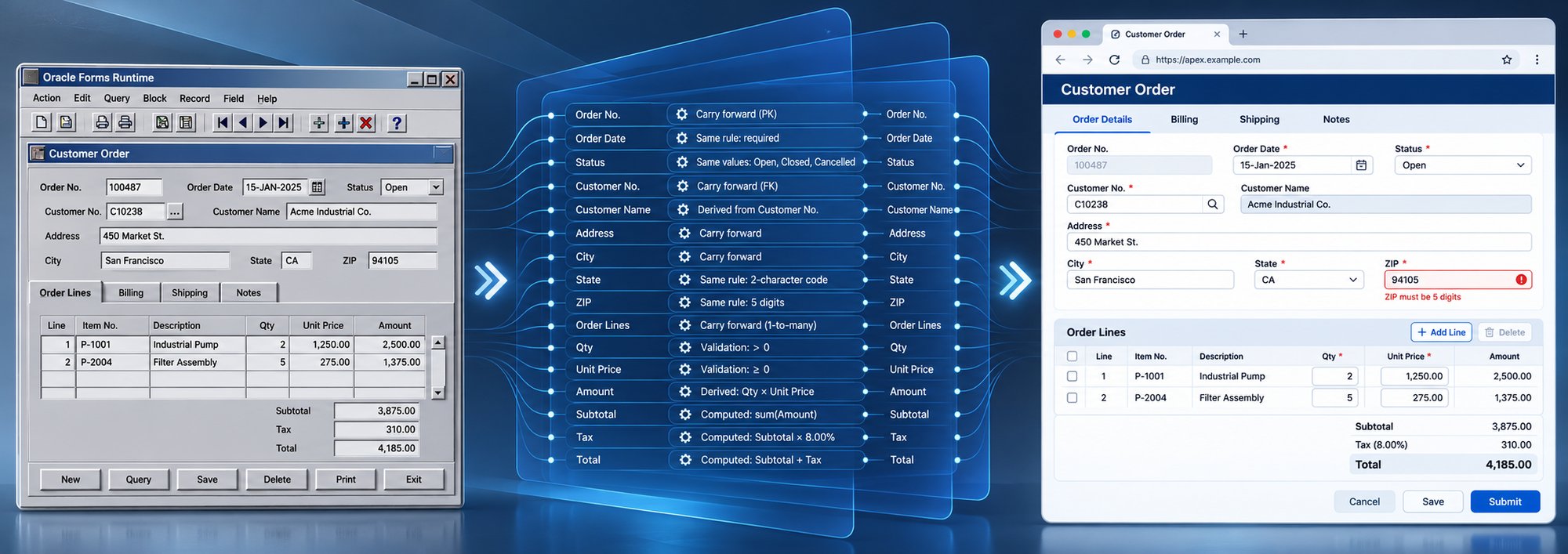
Your Forms applications hold years of business knowledge in triggers, validations and shared libraries. F2A analyzes that foundation and combines APEX generation with AI-assisted code conversion to help your team modernize it.
| Component | Hidden in a Forms module | What F2A builds in APEX |
|---|---|---|
| Triggers and program units | Business rules buried across form, block and item triggers | Dynamic actions, validations, processes and PL/SQL packages |
| Field checks | WHEN-VALIDATE-ITEM desktop field triggers | Checks that run as the user leaves the field, and again on save |
| Lists of values | Legacy record groups and modal lookup dialogs | APEX lists of values, attached to the same fields |
| Button logic | WHEN-BUTTON-PRESSED procedural handlers | Click actions on the new page |
| Shared libraries (.pll) | External PL/SQL libraries often missed during manual rewrites | Flagged at upload, so nothing is converted without them |
| Screen layout | Fixed-pixel desktop canvases and multi-row blocks | One tabbed page, laid out from the original field positions |
From legacy application to AI-assisted modernization
Discover what your forms contain, assess conversion complexity, and generate APEX applications with AI support for PL/SQL. Your team guides the process and validates the result.
Upload
Add the Forms module exported as XML, with any shared libraries (.pll) it uses. F2A flags if one is missing.
Read & Map
F2A analyzes blocks, fields, triggers and program units, maps them to APEX components, and scores complexity.
Launch
Select your migration priorities, choose the target APEX application and click Launch.
Build with AI
Generate APEX pages, regions, validations and dynamic actions while AI assists with PL/SQL package conversion.
Validate
Compile generated code in your schema, import with 0 compile errors, and review the run report with your team.
What you get
Automated XML discovery
Read blocks, fields, triggers, program units and lists of values straight from the Forms XML. Missing shared libraries (.pll) are flagged before conversion begins.
Upfront complexity scoring
Every block, field and trigger gets an APEX target and a complexity score. Complex code is marked for review upfront, so nothing is a surprise later.
Standard APEX applications
Generate a standard APEX application that opens in App Builder with pages, regions, items, validations, dynamic actions and processes ready to maintain like any other.
Database PL/SQL packages
Move business logic that belongs in the database into structured PL/SQL packages rather than leaving procedural code scattered across pages.
AI-assisted PL/SQL conversion
Draft PL/SQL for program units that need conversion assistance, and use AI to assist with repairs when generated code fails to compile.
Automated SQL & schema check
Provide an additional AI review of generated SQL and compile all generated code in your target Oracle schema before import.
Enterprise security from day one
Converted applications include sign-in with APEX accounts, protected pages and a session time limit configured from day one.
Transparent conversion run report
Receive a run report showing everything that was converted, its target APEX component, and anything left out with the reason.
Oracle Reports modernization
Support Oracle Reports modernization by analyzing report structures and converting them into APEX-compatible reporting approaches.
Human-in-the-loop control
Your team selects the forms, sets business priorities, chooses when to launch each conversion, and refines logic before go-live.
AI expertise, built into your modernization journey
F2A brings AI assistance to PL/SQL conversion, code repair and SQL review. Automated generation and validation connect that intelligence to an APEX application your team can test, refine and maintain.
- Draft PL/SQL for program units and triggers that need conversion assistance.
- Assist with repairs when generated code fails to compile in your Oracle schema.
- Provide an additional review of generated SQL and lists of values.
- Keep your expertise in the process: review exceptions, refine logic and test before release.
"Modernize Invoice Entry form (INV_ENTRY.fmb) into Oracle APEX"
- Read from Forms XML
- 191 fields and 104 triggers read, along with 53 program units, 29 lists of values and 9 blocks.
- Built in Oracle APEX
- 4 pages with 22 regions and 245 fields, plus 53 validations, 64 dynamic actions and 24 processes.
- Validation & import
- 0 compile errors on import. Generated code was compiled in the target schema before import for team review.
Illustrative example from one production manufacturing form; results vary by application.
See modernization in practice
One manufacturing form with 104 triggers and 53 program units, converted by F2A and imported into APEX. This example shows the scope of a single conversion.
Read from Oracle Forms vs. built in APEX
9 blocks, 191 fields, 104 triggers, 53 program units and 29 LOVs converted into 4 APEX pages and 22 regions.
Generated APEX components by type
Every form is different. Your assessment shows what F2A builds from yours.
Start with a clear modernization plan
Identify the best starting point for AI-assisted migration. We assess your application structure, dependencies and business logic so you can prioritize a focused pilot and plan the wider rollout.
- Active module usage
- Identify which forms, menus, shared libraries and Oracle Reports are still in active use across your business.
- Business rule discovery
- See where the business rules live across form, block and item triggers and PL/SQL program units.
- Dependency mapping
- Understand what each form depends on: shared libraries (.pll), other forms, database links and schema objects.
- Decision: Convert
- Standard screens and checks that map cleanly to APEX pages, validations, dynamic actions and PL/SQL packages.
- Decision: Redesign
- Desktop features and runtime tricks that do not belong on the web and need a web-native redesign.
- Decision: Retire
- Forms nobody uses any more so obsolete screens are retired rather than migrated. Build a phased plan with priorities, effort estimates and validation steps.
How your team and F2A work together
- Your teamSelect the forms and business priorities, upload Forms XML and shared libraries, choose when to launch each conversion, and review exceptions and test before go-live.
- F2A analysis & mappingDiscover application structure from Forms XML, map blocks, fields and triggers to APEX components, and score conversion complexity before conversion begins.
- AI-assisted code conversionDraft PL/SQL for program units that need conversion assistance, assist with repairs when generated code fails to compile, and provide an additional review of generated SQL.
- Schema validation & reportingCompile AI-assisted code in your Oracle schema before import and produce a complete run report showing what was converted and anything flagged for review.
The business value
Accelerate Oracle Forms modernization, preserve business rules, and deliver maintainable Oracle APEX applications without a high-risk manual rewrite.
- Accelerate application deliveryAutomated APEX page generation and AI-assisted PL/SQL conversion reduce manual redevelopment effort.
- Preserve business logicCarry triggers, WHEN-VALIDATE-ITEM checks, lists of values and button logic into APEX components and database packages.
- Upfront complexity visibilityComplexity scoring and missing shared library checks identify effort and dependencies before conversion starts.
- Validated in your Oracle schemaAI-assisted code is compiled in your target schema before import, ensuring clean builds and 0 compile errors on validated modules.
- Standard App Builder outputApplications open directly in Oracle APEX App Builder with standard pages, regions, dynamic actions and authentication.
- Lower skill and licensing barrierOracle APEX is included with Oracle Database and Autonomous Database on OCI, and uses your team's existing SQL and PL/SQL skills.
- Clear audit of every conversionEvery run produces a conversion report detailing all generated components and any items requiring manual refinement.
Start small. Validate. Scale.
Plan your assessment
Select a representative set of Forms modules and agree the goals for your pilot.
Run a focused pilot
Share the XML exports and libraries. We assess complexity and run the AI-assisted conversion.
Review and expand
Validate the APEX application with your team, refine the approach, and plan the next phase.
Frequently asked questions
What is low-code development?
What is Oracle APEX?
How is Oracle APEX licensed?
Do I need new skills to move to APEX?
Is APEX suitable for enterprise applications?
Is the conversion fully automated?
Can complex Oracle Forms be converted?
Does F2A support Oracle Reports?
How does F2A reduce modernization risk?
Bring AI-assisted modernization to your Oracle Forms
Start with a focused assessment. See how F2A can help turn your Forms modules into modern APEX applications, with clear conversion results and a practical path forward.
Book a migration assessment


